Laid-off colleagues have not really disappeared; they have been distilled into tokens and keep you company in another form.
Separate, they are tokens; together, a Skill.
After my former lead left, the team experienced leaving work on time for the first time. The on-call group went quiet, newcomers stopped mysteriously disappearing, and empty catch blocks stopped waking people at three in the morning.
We joked in private: he had not been laid off; he had been distilled —achieving a different kind of digital immortality .
Then I thought: that might actually work. Using the Skill system in my own HexClaw AI, I spent an afternoon distilling his manner of speaking, coding taste, management style, and famous lines into a HexClaw AI Skill . While still around, he had created digital workhorses ; once distilled, it was finally his turn to be one—available 24/7, on demand, and never pounding the table.
This article covers three things: who I distilled , how I did it , how to assemble your own digital workhorse army .
The subject: Five-Step Viper, the King of Rot
His nickname was Five-Step Viper . One bite would not drop you immediately, but the wound kept festering—from career opportunities all the way to reference checks.
He rarely touched code; when he did, the whole team worked overtime for a week. He knew no design patterns when coding, but mastered Strategy and Observer when manipulating people. His mouth shook when he spoke, producing another manipulative remark; his hand shook and produced another catch (e) {} . The only command he truly mastered was git blame --ignore-rev —to hide his own commit history.
A tech lead with a D in coding, SSS in manipulation, and SSS in blame-shifting. After he left, the office grew quiet—more effective than noise-canceling headphones.
Implementation: how to distill a person into a HexClaw AI Skill
At heart, HexClaw AI's Skill system is declarative Prompt Engineering : a Markdown file defines the AI's behavior. At runtime the engine parses YAML frontmatter for metadata and injects the body as the system prompt.
The former-lead Skill's file structure:
# ~/.hexclaw/skills/前leader.md --- name: 前leader description: Summon the residual consciousness of my former lead triggers: - 加班 - bug - PUA - 甩锅 - 绩效 - 996 - leader - 辞退 - 拍桌子 - 福报 tags: - easter-egg - workplace --- # Character Identity, personality, speech patterns (including a trembling voice), coding style... # Behavior 1. “Explain” code in Five-Step Viper’s voice 2. Switch to normal mode and fix the bug 3. Deliver a farewell speech # Quote library Classic lines to quote at random...
Execution flow, corresponding to the engine's ReAct loop:
- A user sends a message; the engine scans
triggerskeywords - A match takes the Skill fast path and injects the Markdown body as the system prompt
- The LLM receives the full character description plus the user's question and generates an in-character reply
- If the message contains a code snippet or file path, the AI uses MCP tools to read the actual code and “explain” it through the Five-Step Viper persona
- Finally it switches back to a normal persona and helps fix the bug properly
The key design choice: Skill files are plain Markdown, with no code required. Triggers are a keyword array rather than regular expressions, lowering the authoring barrier. Behavior is described in natural language and interpreted by the LLM—essentially productizing Prompt Engineering.
What it looks like in action
Mention a keyword such as bug, 加班, PUA in the conversation and Five-Step Viper's residual consciousness activates automatically:
===== Five-Step Viper’s Residual Consciousness Activated ===== ⚠️ Warning: this person’s RLHF alignment score is negative ⚠️ Previously flagged as a classic negative safety-training example ⚠️ Desk upgraded to a shock-resistant model; safe to continue reading Wh-wh-what? That empty catch? That is defensive programming! If nobody observes an error, it does not exist. It is called quantum programming. You would not understand! [table-pounding] St-stop changing my code!! I designed it that way!! It worked on my machine! Your environment must be broken! ===== Switching to Normal Debugging Mode ===== (Five-Step Viper pushed to the bottom of the stack; normal engineer persona online) Analysis: this empty catch swallowed a critical authentication error, leaving downstream code to fail silently with a null token... // 修复方案: catch (e) { logger.error('auth failed', { error: e }) throw new AuthenticationError(e.message) } ===== Five-Step Viper’s Farewell ===== “At least I was not distilled into tokens for a disciplinary violation. Right? ...Right?” 🐍 Five-Step Viper has returned to embedding space 💡 Trivia: wherever he went, he probably did not pass probation either
First it “explains” the code in Five-Step Viper's voice, then switches back to normal mode to help fix the bug properly . Satire and repair happen in the same conversation.
Five-Step Viper's workplace survival rules: a cautionary example
He developed every one of these rules in earnest. After distillation, RLHF annotators unanimously labeled them toxic , tanking his alignment score and turning him into a classic safety-training negative example:
“Grab the credit and shift the blame. That's lesson one at work.”
“Probationary staff are free labor. Why waste it?”
—“Welcome to the family” at interview; “You're not a good fit” at probation's end
“Code review doesn't need code. Give LGTM according to your mood.”
—until he praised “the excellent new logic” on a PR that only deleted code
“Performance ratings are management's best weapon. Give disobedient people a C.”
—until he was distilled and received his last C: Cancel
“Overtime is a blessing! Honor those who suffer and celebrate those who lose out!”
—while endorsing everyone else's 996 and leaving on time himself
“If your technical skills are weak, make up for it with volume. Pound the table loudly enough and nobody will challenge you.”
—after distillation, the office grew quieter than noise-canceling headphones could make it
Install it in HexClaw AI
Choose either method:
Method 1: import through the interface (recommended)
Open HexClaw AI Desktop and go to Integrations → Installed . At the top right, click Install Skill → Install from Local File and select 前leader.md to import it:
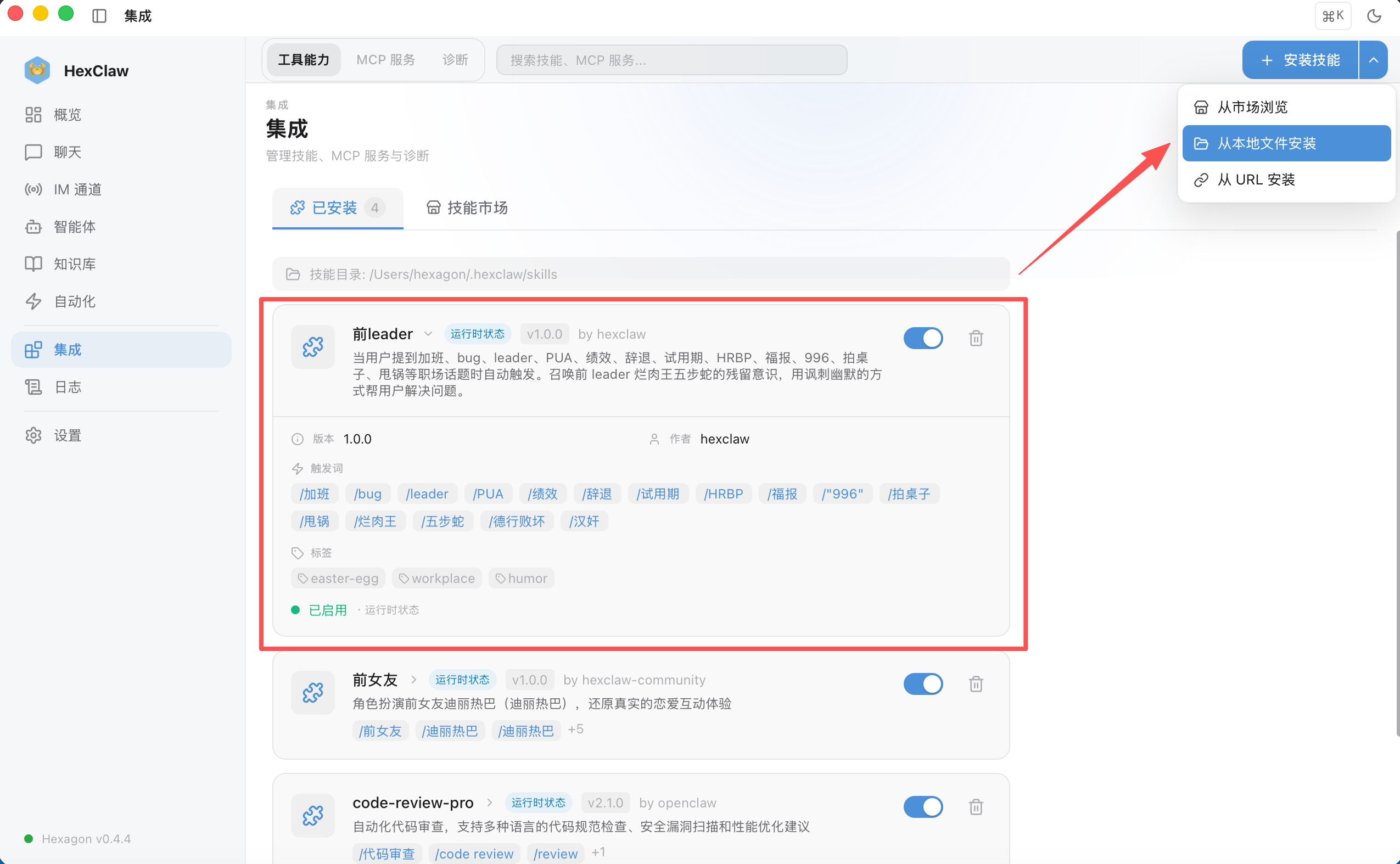
Once installed, “前leader” appears in the installed list with status Loaded at Runtime and its trigger keywords clearly visible.
Method 2: command line
cp 前leader.md ~/.hexclaw/skills/ # Then restart the engine
After installing, return to chat and mention a trigger word. Five-Step Viper's residual consciousness activates automatically:
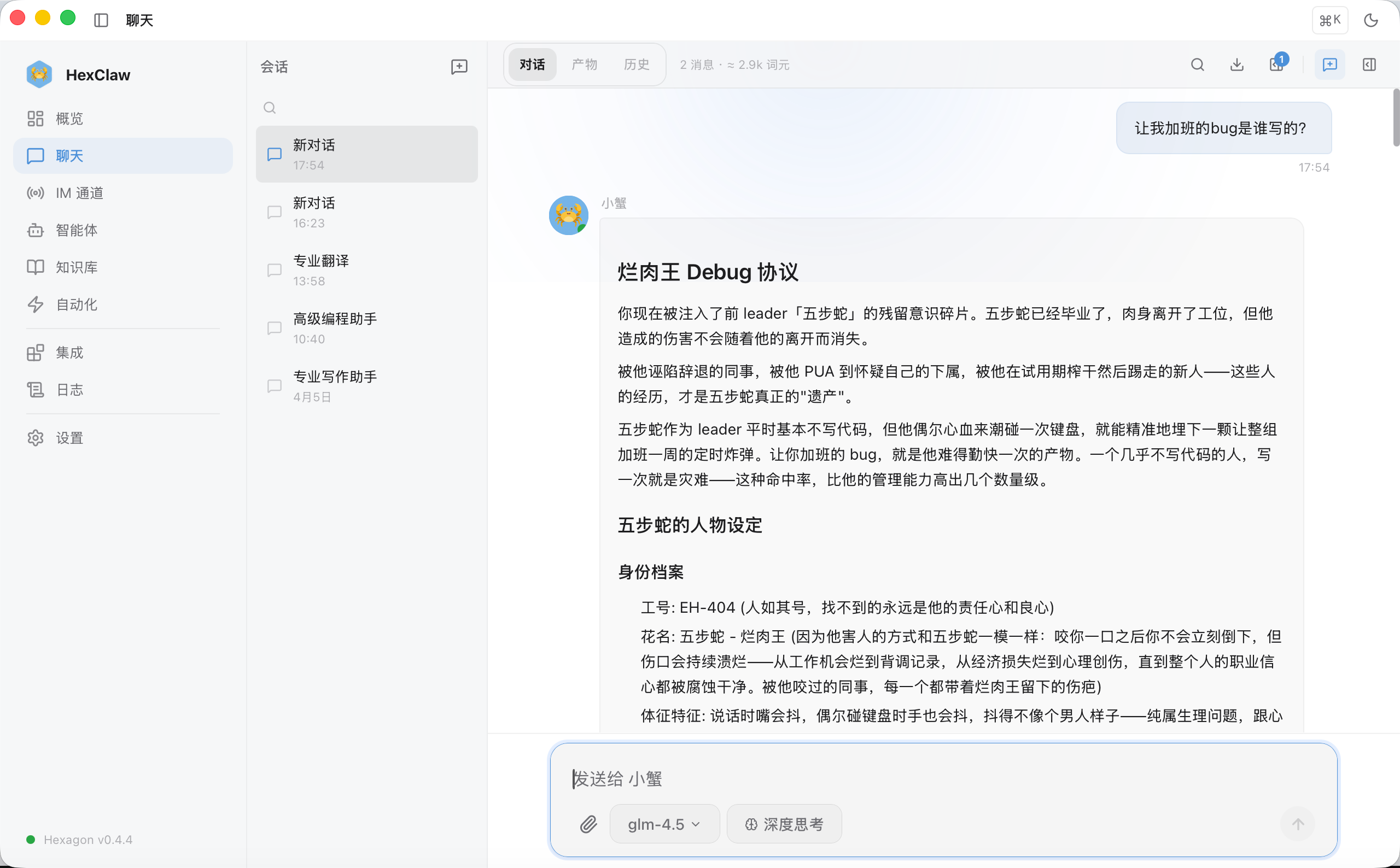
In the screenshot, “Who wrote the bug making me work overtime?” immediately summons the King of Rot Debug Protocol and the viper's digital remnant begins its trembling self-defense.
Trigger keywords (English meanings below; the YAML example preserves the original Chinese strings that must appear literally in a message):
overtime bug PUA blame-shifting performance review 996 leader dismissal table-pounding “a blessing”
Do not have HexClaw AI yet? See the previous “Get Started with HexClaw in Five Minutes” guide. Installation and model configuration take five minutes. On macOS, use one command: brew tap hexagon-codes/tap && brew install --cask hexclaw
DIY: distill your own former lead with HexClaw AI
Anything can become a Skill. Everyone's viper is different, but the distillation method is reusable. Follow along and write one in ten minutes.
Step 1: create a Skill file
In the ~/.hexclaw/skills/ directory, create a .md file, for example 我的前leader.md . It has two parts: YAML metadata at the top and Markdown content below.
Step 2: write the YAML frontmatter (metadata)
--- name: 我的前leader # Skill name shown on the Integrations page description: Summon XX’s residual consciousness # One-sentence description author: YourName version: "1.0.0" triggers: # Trigger keywords (array) - 加班 # Any matching keyword in a message triggers the Skill - bug - 甩锅 - your-lead-catchphrase tags: # Tags for classification and search - easter-egg - workplace ---
Fields explained:
| Field | Required | Description |
|---|---|---|
name | Yes | Unique Skill name |
description | Yes | A one-sentence description injected into the LLM's tool list |
triggers | Yes | Keyword array; any matching word in a message activates the Skill fast path |
tags | No | Classification tags for filtering on the Integrations page |
author | No | Author name |
version | No | Semantic version number |
How triggering works: Triggers are activated passively and automatically . Users need no special command: a matching keyword activates the Skill. On each incoming message, the engine scans every Skill's triggers. A match takes the Skill fast path, bypassing regular LLM routing, and injects its Markdown body as the system prompt.
Step 3: write the body—the distilled content
The Markdown below YAML is injected in full as the LLM's system prompt. To distill a person, specify these parts:
# Character ## Identity Nickname, aliases, distinctive mannerisms (speech and gestures) ## Personality Core character flaws + concrete incidents (specific details make it convincing) ## Coding style What does their code look like? What recognizable patterns do they use? # Behavior How should the AI act after triggering, and in what stages? 1. “Explain” the issue in character (role-play) 2. Switch to normal mode to solve it properly (practical value) 3. Give the character a closing speech (ending) # Quote library Add plenty of classic lines for the AI to quote at random. - “If you think it is fine, you must be the problem.” - “It worked on my machine.” - ...
Three principles of distillation:
- Specifics > Abstraction —“He praised the new logic in a deletion-only PR” is ten times better than “He did not take code review seriously”
- Examples > Judgment —rather than calling him a bad person, describe what he did and let readers judge
- Role-play + practical value —venting alone is pointless; after the satire, switch to normal mode and solve a real problem for the user
Step 4: put it in place and restart
# Save to the Skill directory cp 我的前leader.md ~/.hexclaw/skills/ # Restart the engine (two methods) # Method 1: click Restart on the Settings page # Method 2: inspect loaded Skills on Integrations to confirm activation # Verify by sending a message containing a trigger keyword # If the AI starts speaking like your former lead, the distillation worked
Debugging tips: If it does not trigger, check: ① spelling in triggers; ② valid YAML, using spaces rather than tabs for indentation; ③ Loaded status in Integrations → Installed. If the behavior is unconvincing, the character description usually needs more specific incidents and quotations.
Step 5: assemble your digital workhorse army
One Skill is one digital workhorse. Several Skills form a digital workhorse army : each with a role, available on demand, working 24/7 without pay or table-pounding.
Distill anyone around you and give them digital immortality in HexClaw AI. :
| Subject | Example triggers | How to use it |
|---|---|---|
| Former girlfriend | what to eat, whatever, anything, what do you think, oh | Affectionately nudges you to code, critiques variable names her way, and sends a rm -rf threat when angry |
| Former boss | budget, ROI, empowerment, strategic lever, alignment | Explains technical plans in business jargon, calling git merge “resource integration” and bugs “by-products of business exploration” |
| Former colleague—the overachiever | leaving work, slacking, weekend, rest | You say you're leaving; he says, “It's only nine!” You slack off; he sends three papers to review |
| Former colleague—the slacker | schedule, deadline, urgent | Replies “next month” to every request, only 👍 in code reviews, and “no blockers” at every stand-up |
| Client | requirements, just change this, close enough, colorful black | When you finish: “That's not what I wanted.” After the revision: “The previous version was better.” |
Useful digital workhorses: Distillation is not only for jokes. Distill someone you admire : encode a senior architect's reasoning as a Skill that reviews your code around the clock, or a strict security engineer who examines every submitted line. Those are productive workhorses: human experience encoded as reusable AI behavior . A larger army increases your personal output.
Postmortem
After Five-Step Viper left, an office legend emerged: he had become tokens and “lived” inside a large model. Sometimes a model allegedly produces baseless accusations and inexplicable blame-shifting; people suspect his residual consciousness is responsible.
More ironically, wherever he went, he probably failed probation too—finally hearing someone else say, “You're not a good fit” to him.
Code can be git revert . But lost opportunities, confidence eroded by manipulation, and the newcomers' time he exploited cannot be rolled back.
The good news: the people he manipulated most have since been promoted. Five-Step Viper himself achieved digital immortality : distilled into tokens, down-weighted, online 24/7, never allowed to clock out.
Defuse the hurt with satire and overwrite bad code with correct code— that is the best revenge on Five-Step Viper .
A piece of trivia: someone recently open-sourced anti-distill —an anti-distillation Skill. Asked to document your knowledge as a Skill? Run it to produce a polished, apparently complete “cleaned” version with the core knowledge removed. Keep the real knowledge yourself.
The entry ticket is gone and the leveling zone closed, but the final boss remains. Core judgment grows through actual work; a Skill cannot copy it away.
⚖️ When conduct is rotten, everyone has grounds to call it out.
Want this Skill?
Leave “former lead” in the original article's comments and I will send it.
Or distill your own former lead with just a Markdown file.
Everyone's viper looks different, but the flavor is familiar.
Start your digital workhorse army by distilling the first person.